Unlocking the Power of Genomics and Health Data for Affordable Care
Availability of large number of human genome sequences along with clinical information and other multi omics data sets hold the key to curative and preventive affordable quality healthcare of the future. Our vision is to solve complex health problems using data-driven approaches while empowering a new generation of health data scientists. Students will collaborate with interdisciplinary teams and internationally acclaimed scientists to use data and make impactful contributions to the field.
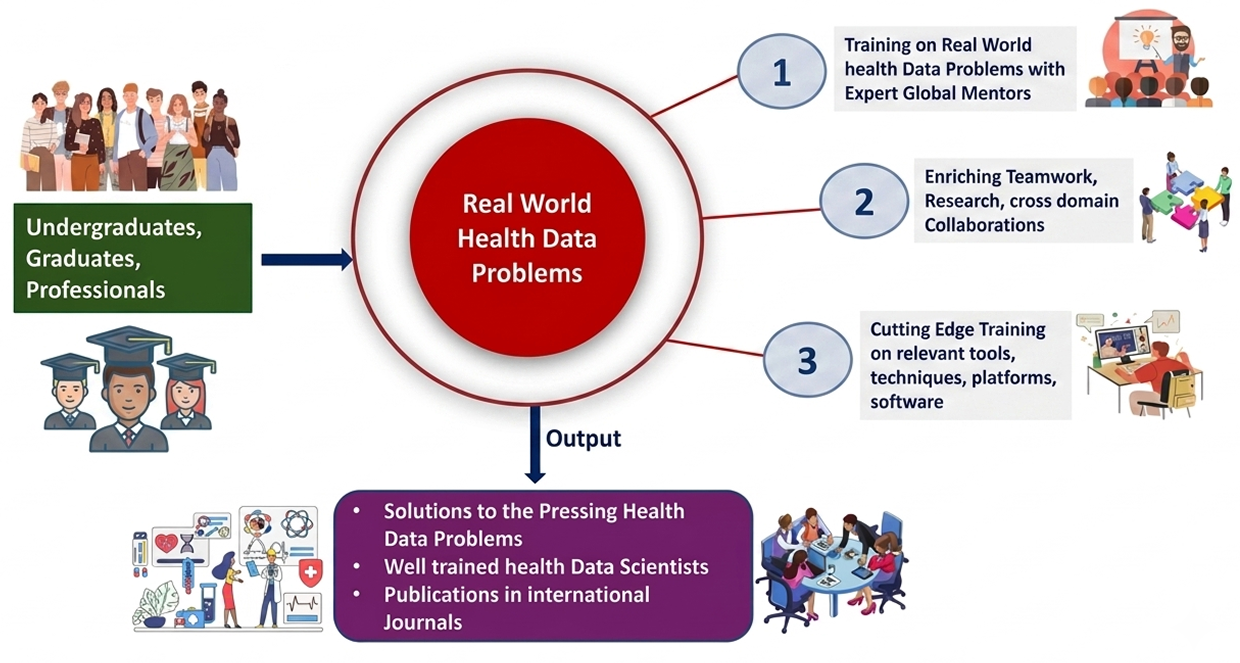
OSDDIN is a first step towards this vision turning open biomedical data into a foundation the global research community can build on.
A unified ecosystem for open drug discovery.
OSDDIN is a web-based platform born from the Open Source Drug Discovery (OSDD) initiative, delivering curated biomedical data from hundreds of sources as an interconnected knowledge graph for open-source drug discovery. Building on the legacy of Science 3.0, it advances toward Science 4.0, where explainable AI and autonomous agents integrate biomedical knowledge to accelerate scientific discovery.
The platform provides a unified AI-driven discovery engine supporting multiple stages of drug discovery through a common knowledge graph and AI reasoning framework. It transforms fragmented biomedical knowledge from databases, publications, and institutional silos into testable therapeutic hypotheses, helping researchers uncover disease mechanisms, therapeutic targets, and clinically relevant biomarkers faster and more affordably.
How it works
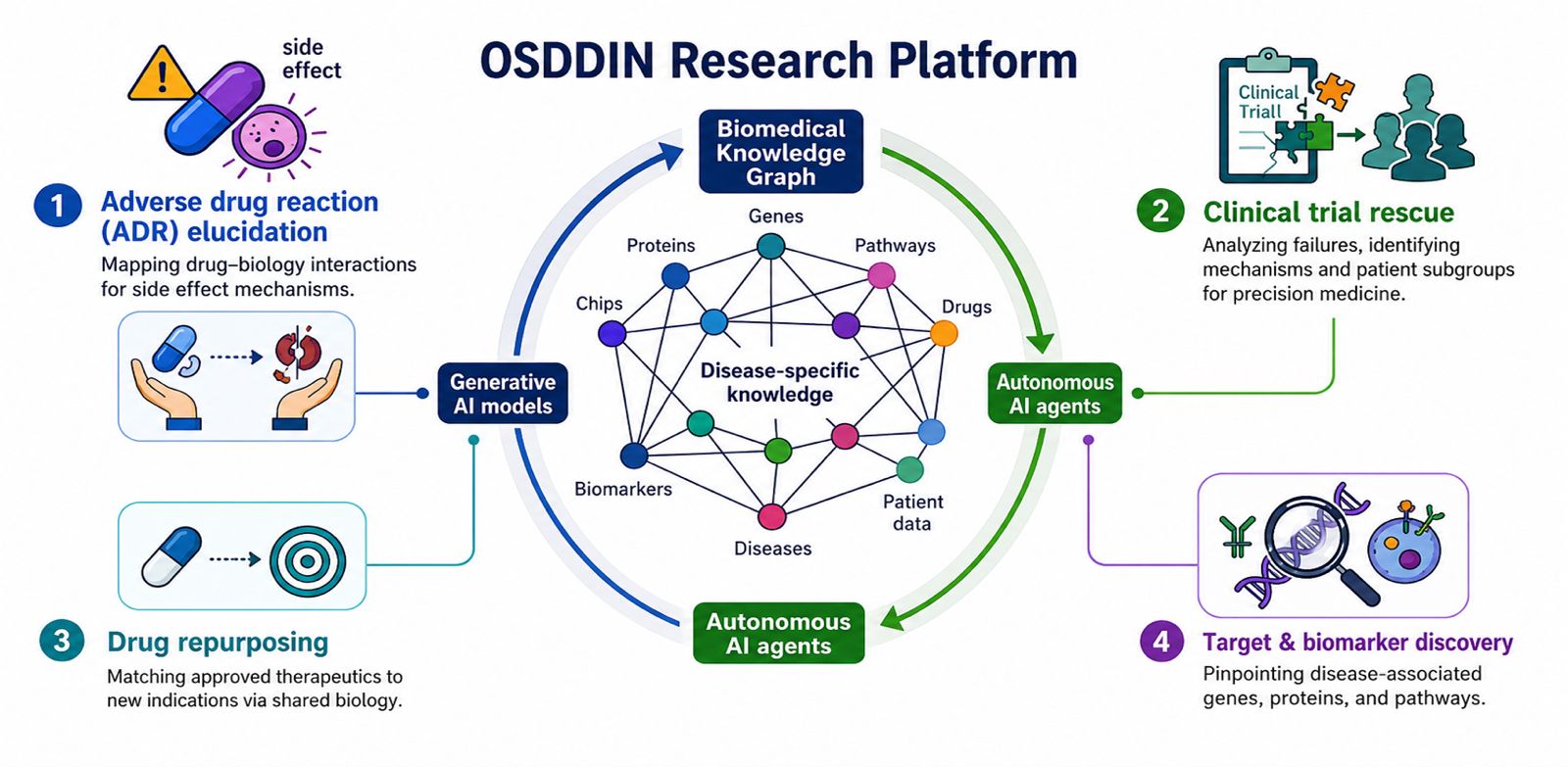
Four workstreams, one common knowledge graph.
01
ADR & Toxicity Analysis
Predictive AI maps drug–target–pathway interactions to uncover mechanistic drivers of adverse drug reactions.
02
Clinical Trial Rescue
Post market and failed trial data analysis stratifies responsive patient subgroups for precision trial redesign.
03
Drug Repurposing
Knowledge graph and network biology analytics identify new indications for already approved compounds.
04
Target & Biomarker Discovery
Autonomous AI integrates multi omic and clinical data to identify biologically validated targets.
What we set out to achieve.
01
Solving Real World Problems & Need Based Research
Apply data science to real health challenges through long term, standalone, community driven software.
02
Learning while Training · Human Resource Development
Hands on training on cutting edge health data analytics — producing developers, not just customers.
03
Interdisciplinary Collaboration
Diverse disciplines tackling health challenges together across biology, clinic, and data science.
04
Innovative Projects & Computational Resources
High risk, open source projects on open infrastructure built for the global research community.
05
Dissemination & Open Source Promotion
Open access publication, community channels, and freely accessible cheminformatics & pharmacoinformatics.
06
IP & Commercialization
Patents and partnerships with industry leaders to translate research into impact.